


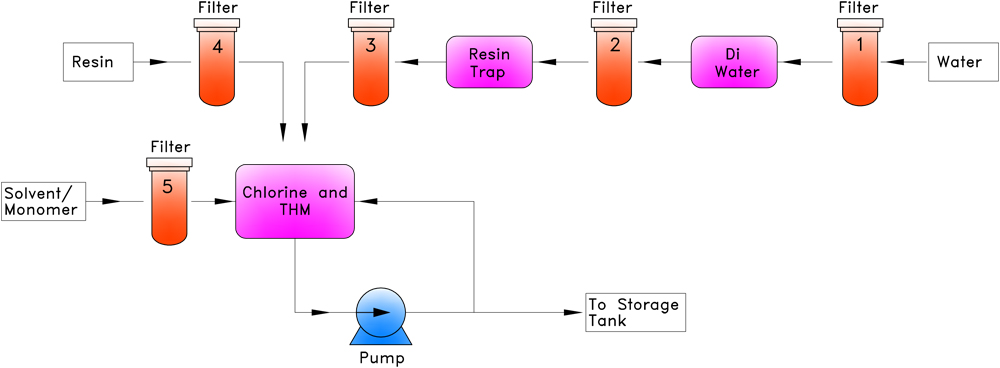
Resins, paints or inks’ final product quality (conformance to specification) depends on the incoming quality of raw materials, intermediates or feed streams. Contaminants introduced at these points have significant impact on the on the product quality and manufacturing costs. The diagram below shows the introduction of the intermediate/feed streams to the dispersion tank or reactor. Proper filtration at these key points with the products listed in the table below will eliminate contaminants before they become a problem.
Problem
Filtration of paints and inks with only a single final filter makes it difficult to ensure product quality and impossible to control costs. Applying filtration only at the end of the production cycle requires:
- Clarification of contaminants introduced by intermediates
- Classification of the pigmented paint
- Removal of solid contaminant, slats, haze, fibers and semi-solids
Retaining product quality using only a single final filter is too demanding for a single filter. Typical work process of continuously recirculating products through the single filter is costly, time consuming, and often does not provide the level of product uniformity demanded by today’s product specifications.
Products Suitable For This Application
| Application Guide for Raw Materials, Intermediates, and Feed Streams | |||
|---|---|---|---|
| Application | Feature-Tec Filter Cartridge | Suggested Absolute Rating |
Recommended Flow per 10″ Filter GPM (LPM) |
| 1. Resin Filtration | ELCPP | 30-70 | 3-5 (11-19) |
| 2. Water Filtration | AC | - | 1-2 (4-8) |
| 3. Resin Trap Filtration | ELCPP | 5 | 0.5µm |
| 4. DI Water Filtration | ELCPP | 5 | 5-8 (19-30) |
| 5. Solvent/Monomer Filtration | ELCPP | 1 | 5-8 (19-30) |


